The Country/Region Report is an overview report designed to provide a quick snapshot of national research performance for any selected country or region. It helps you answer questions such as:
- How is this country performing over a given period?
- In which research areas is it most active?
- How international and collaborative is its research?
- How does it compare with other countries?
Rather than requiring you to build analyses from scratch, the Country/Region report assembles key indicators, trends and breakdowns into a single, navigable view.
Configuring the Country/Region Report
After opening the report, you can refine the view using the filters at the top:
- Country/Region - Select the country or region you want to analyse.
- Date range - Define the publication period to include.
- Include ESCI Documents - Choose whether to include or exclude documents from ESCI.
- Document Type - Restrict the report to specific output types (e.g. articles, reviews).
- Research Area Schema - Select the schema used to classify subject areas, including all national schemas.
Note: The selected research area schema is particularly important for any indicator that is normalized by subject, such as CNCI. CNCI is normalized by year, document type, and subject category as defined in the chosen schema.
The report is organized in several pages: Research Performance, Collaboration, Benchmarking and Most Cited Documents.
Research Performance
The Research performance page brings together KPIs and trend charts so you can quickly understand both the scale and quality of a country’s research and who is driving it.
At the top, you see key indicators such as documents published, times cited, percentage of documents cited, percentage of documents in the top 1% and top 10% most cited, and average CNCI, giving you an immediate snapshot of volume and impact.
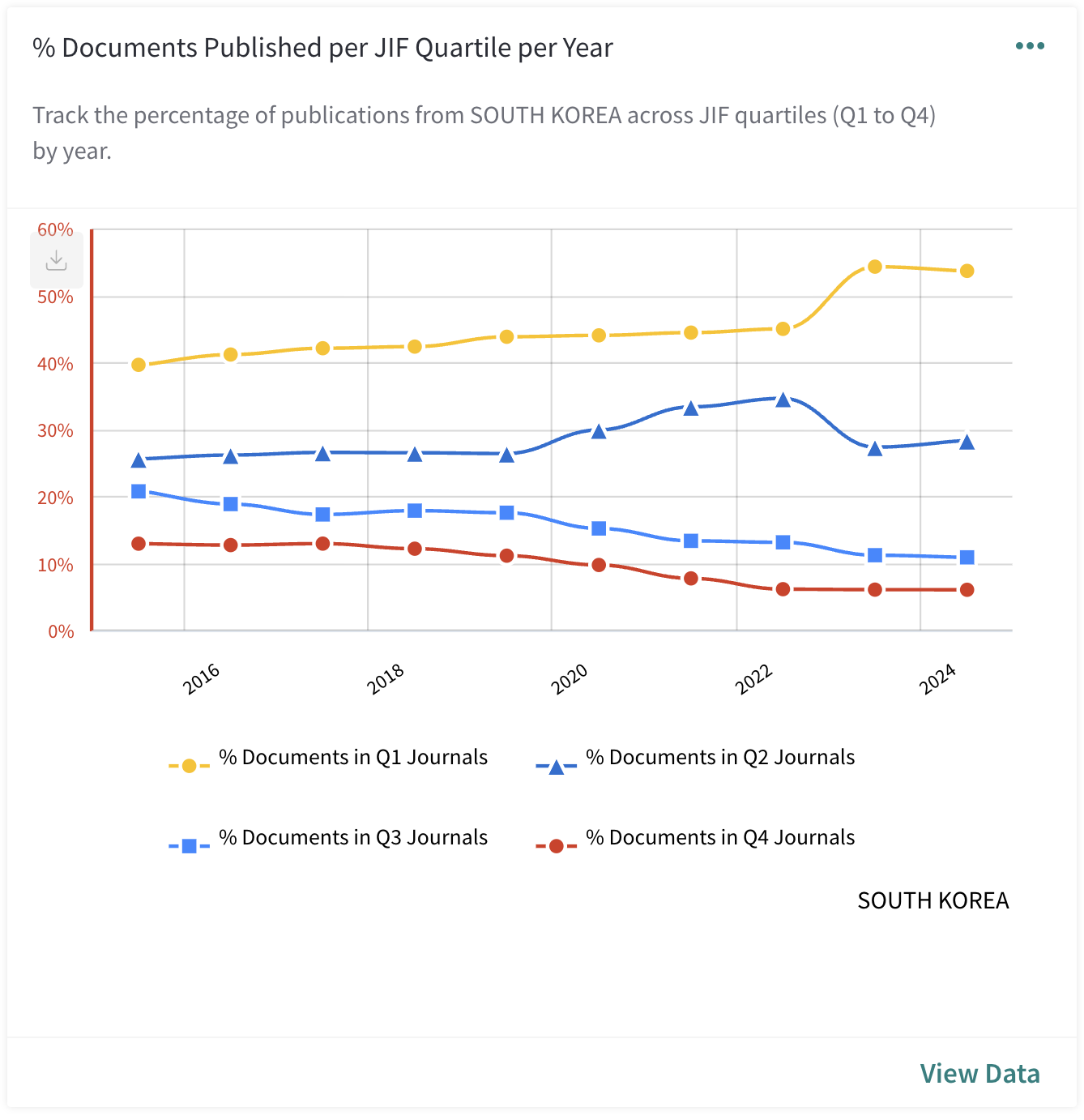
Below, time-series charts show how these evolve over the selected period – including productivity indicators (documents published), impact indicators (e.g. CNCI), excellence indicators (e.g. documents in top 1%), and relevance indicators (e.g. %documents per JIF quartile).
A dedicated view of top contributing institutions highlights which organizations within the country are most responsible for its output and influence.
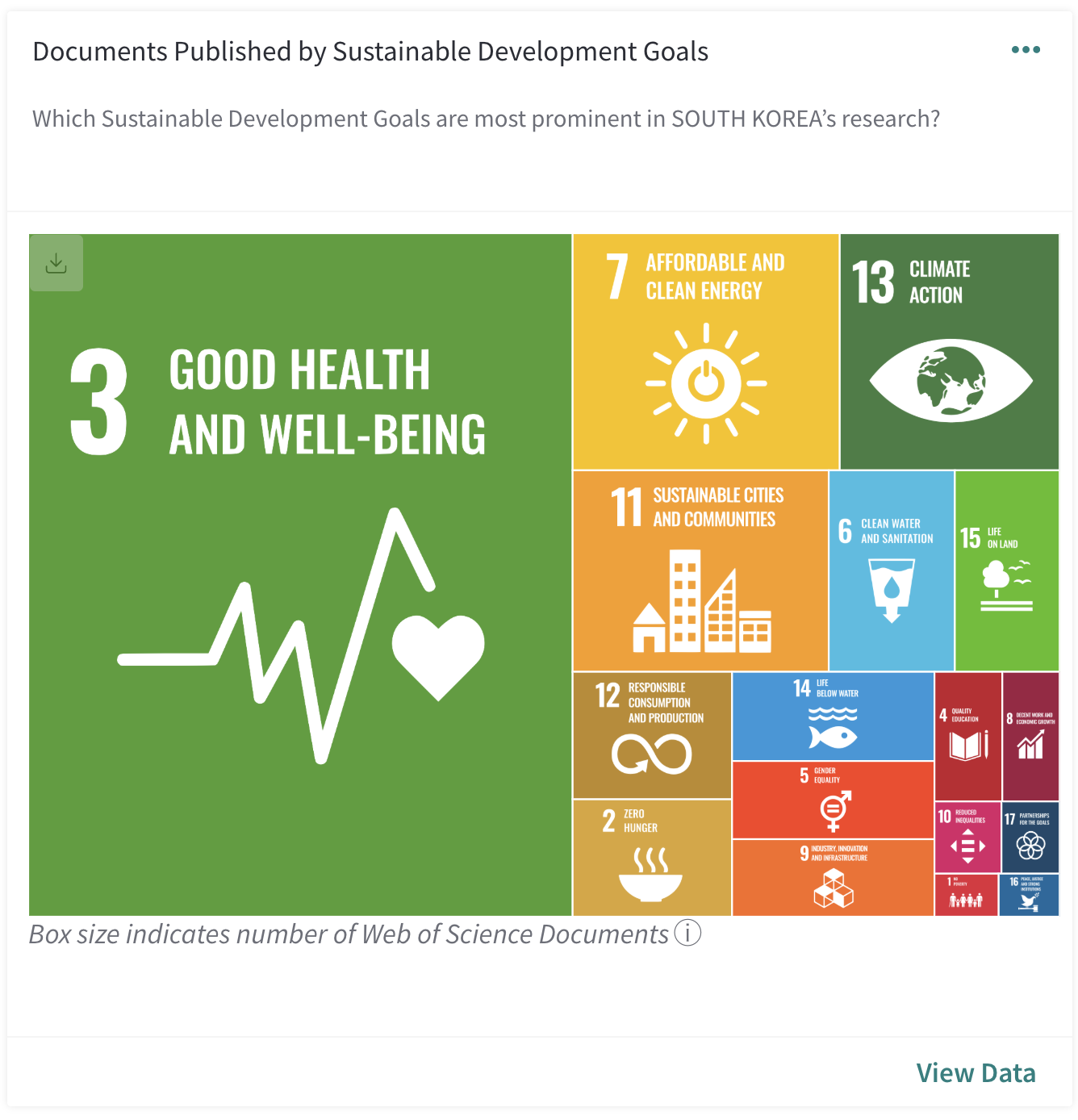
To show where the country is most active scientifically, the page also includes several standard Research Area Schema breakdowns, such as Web of Science categories, emerging topics, micro-citation topics, and Sustainable Development Goals (SDGs).
In addition, you see a breakdown based on the research area schema you selected at the top of the report, showing how output is distributed across its subject categories and helping you quickly identify national strengths or focus areas.
Together, these elements help you quickly answer questions such as:
- Is national research output and citation impact increasing, stable, or declining over time?
- Are more of the country’s publications entering the top 1% and 10% most cited globally?
- Is there a shift in where researchers publish, for example towards higher-impact journals?
- Which institutions are the main contributors to the country’s research volume and impact?
- In which subject areas is the country particularly strong or emerging?
Collaboration
The Collaboration page brings together partner, output, and impact views so you can see how a country collaborates, with whom, and what that means for quality.
At a glance, you can see how much of the country’s output is produced with international partners, how this compares with a global baseline, and how collaboration patterns evolve over time. The page highlights which other countries and institutions are most frequent co-authors.
A dedicated collaboration-type view lets you distinguish between publications produced within a single institution, across multiple institutions in the same country, and those involving partners in other countries, and then see how the balance between these types changes over the selected period.
On top of this, the collaboration-based impact indicator, Collab-CNCI, help you understand whether the country’s citation performance is primarily driven by international partnerships, by strong domestic collaboration networks, or by single-institution research.
You can see, for example, whether international collaborations consistently outperform domestic work, or whether certain forms of domestic collaboration are also delivering high impact.
Together, these elements help you answer questions such as:
- Is our research becoming more or less international over time?
- Which countries and institutions are our most important collaboration partners?
- To what extent is our citation impact driven by international collaboration versus domestic or single-institution research?
Benchmarking
The Benchmarking page allows you to place a country’s performance in context by comparing it with one or more peer countries. After selecting your focus country, you add peer countries you want to compare against – for example, regional neighbours, countries of similar size, or strategic targets for collaboration.
The page then shows these countries side by side across a shared set of indicators and time periods, so you can see differences in output, impact, and collaboration patterns at a glance.
You can compare countries in terms of research volume and trends (how many documents they publish and how this evolves over time), and citation impact (for example, CNCI and Collab-CNCI over time). This helps you see not only who publishes more or less, but also who achieves higher impact and how that relates to their collaboration profile.
Together, these elements help you answer questions such as:
- Are we growing faster or slower in publication output than our peers?
- Are we matching, lagging, or outperforming similar countries on citation impact?
- Do we rely more or less on international collaboration for high impact than comparable countries?
- Which countries show performance patterns or trajectories that we might want to emulate, learn from, or investigate further?
Most Cited Documents
The Most Cited Documents view surfaces the publications that are driving a country's citation impact the most under your current filter settings.
Working with tiles and data
Across all pages of the Country Report, standard InCites functionality is available:
- View data / Analysis – Open any chart or tile to view the underlying data and filters.
- Save to report – Save individual tiles into your own custom reports.
- Save as – Save the Country Report as your own report and modify filters or configuration.
- Export and share – Download the report as a PDF or share it with colleagues.